Flood
Floods
Flooding is a natural phenomenon
Floods are natural phenomena caused by rainfall, snowmelt or a combination of both. During flood events in France, the normal flow of a watercourse can increase tenfold within a few hours (torrential flash floods of the "Cévenol" type) or within a few days (lowland or river floods) on the main rivers.
Dams have been designed to withstand floods.
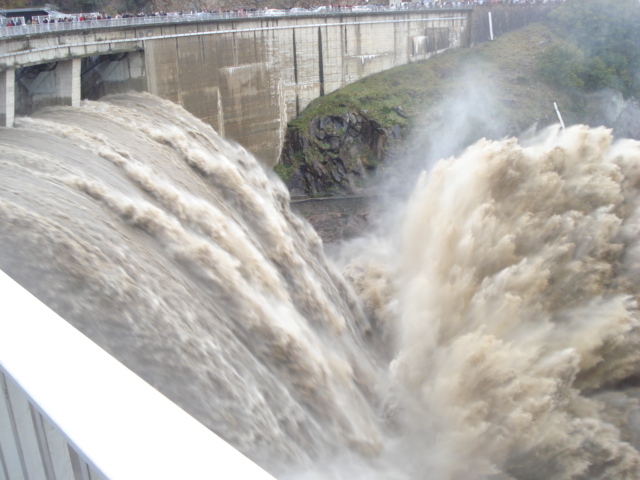
Since the volume of water brought by a major flood often exceeds the storage capacity of large reservoirs, dams have been equipped at the design stage with special devices located at the crest or base of dams, known as spillways, which allow the passage of extreme flows without compromising the structural integrity of the structures.
They have been designed to withstand floods of very low probability. Current practice for French structures consists, for large French dams, of providing protection against:
- the 1,000-year flood for concrete dams
- the 10,000-year flood for embankment dams (which are more susceptible to overtopping risk).
These floods therefore greatly exceed those taken into account for the design of flood protection embankments.
The outflow from a dam must not, as far as possible, exceed the inflow (this is not always possible for uncontrolled free-overflow dams). In order not to worsen the consequences of the natural flood or endanger the safety of the dam, operators are required to comply with two fundamental operating principles:
- The maximum outflow from the dam must never exceed the maximum flow reached by the flood upstream.
- The operator must not worsen the natural flood.
Thus, when faced with a flood, dam operators always prioritise the protection of people and property, in particular by protecting the dam.
Dam operators try to anticipate floods by relying on hydrometeorological forecasting technical services and flood warning services.
Systems are available to estimate the flood flows that will be reached on downstream reaches and to alert dam operators somewhat in advance, so that the necessary measures can be implemented. Operating rules in the event of floods are defined in consultation with the prefectures and the DREALs.
The role of the operator during flood periods
During a flood, the operator manages the structure in accordance with the instructions approved by the supervisory authority (DREAL or DDT) on behalf of the Prefect.
At the start of a flood, the operator notifies the authorities of imminent spillage from the dam due to the natural increase in upstream flows.
For run-of-river structures, the operator may during a flood be required to open the gates fully. In this case, the flow of water becomes completely free again and the river returns to its natural channel. The dam is said to be "transparent" and the operator no longer has any control over the river flow.
**Further information
ICOLD has published a very large number of documents, reports, bulletins... devoted to the subject of floods and dam spillways.
See also the document "Recommendations for the design of dam flood spillways" published in 2013, available on the "Recommendations" page.