



Earthquakes
Dam accidents related to earthquakes are rare. ICOLD publications show that the most significant accidents involve embankment structures, which are inherently more susceptible to seismic action than concrete dams.
This good behaviour can be intuitively explained by the fact that dams are massive structures inherently designed to resist significant horizontal forces (reservoir thrust), unlike conventional civil engineering structures which are designed to carry essentially vertical loads.
For embankment dams
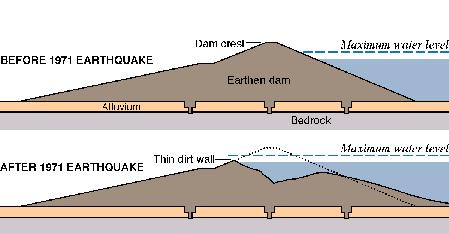
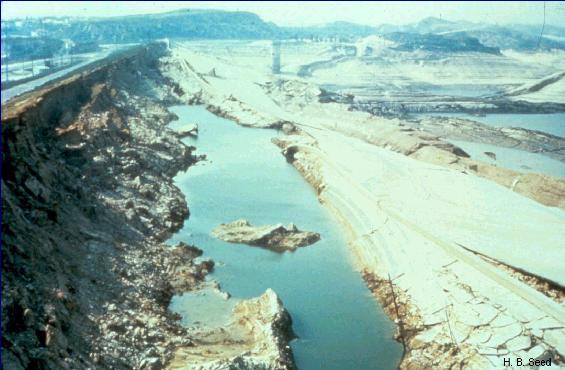
The worldwide feedback is that no large modern embankment dam over 15 m in height has failed as a result of an earthquake. The partial failure, which has been very extensively studied, of the Van Norman dam (San Fernando earthquake of February 9, 1971) is the most notable example.
It should be noted that, apart from atypical mine tailings dams, only one dam damaged by an earthquake has caused casualties. This was the small Fujinuma dam, built in 1947, during the terrible Tohoku earthquake in Japan in 2011.
In Japan, apart from the Fujinuma dam, only embankment dams built before 1918 were seriously affected by earthquakes, and only one failed.
For concrete dams
No concrete or masonry dam has suffered destruction during the most violent earthquakes, with the exception of the Shih-Kang diversion dam (Taiwan), built directly on a major seismic fault.
The presence of this fault, roughly parallel to the valley and undetected during construction, caused a vertical displacement of 3 to 4 m between the gated openings on the right bank, but without a catastrophic release of water from the reservoir.
Whether arch dams or gravity dams, in concrete or masonry, the overall stability of the structures was not compromised and the observed damage proved to be minor (appearance of cracks in the upper part of structures generally localised at changes in structural inertia, openings or offsets at monolith joints).
Further information
See also on the "Recommendations" page the guide from the Directorate General for Risk Prevention of the Ministry of the Environment on seismic risk and the safety of hydraulic structures.
The International Commission on Large Dams (ICOLD) is a privileged source of information on dam behaviour, particularly in the event of earthquakes. The theme of "dams and earthquakes" has been addressed on several occasions at the congresses organised by ICOLD every three years. The ICOLD document published in 2002, entitled "ICOLD Position Paper on Dam Safety and Earthquakes", provides an initial overview of dam behaviour during sometimes very significant earthquakes. It is available free of charge on the ICOLD website.
Reference may also be made to the general report and reports from Question 83 of the Montreal Congress on dams and earthquakes (2003), or ICOLD Technical Bulletin No. 120.