


Landslides
Landslides on reservoir banks can represent a potential risk for dams.
The sudden entry into the reservoir of a large volume of earth at sufficient speed is liable to generate a wave that could overtop the dam.
The risks would then be twofold:
- Dam failure due to overtopping: instantaneous but short-lived increase in hydrostatic load on the dam, or erosion of dam materials in the case of embankment dams
- Risk of flooding downstream from the volume of water that has overtopped the dam.
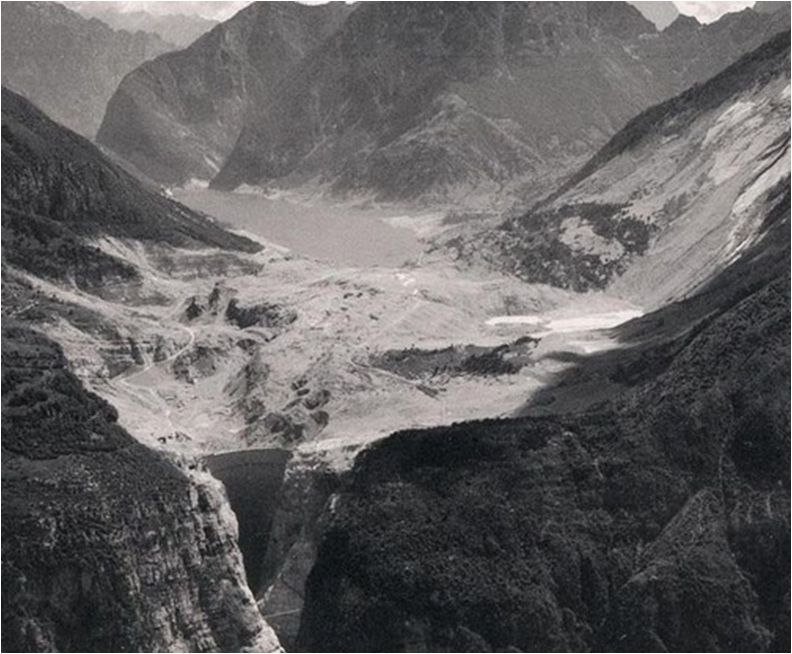
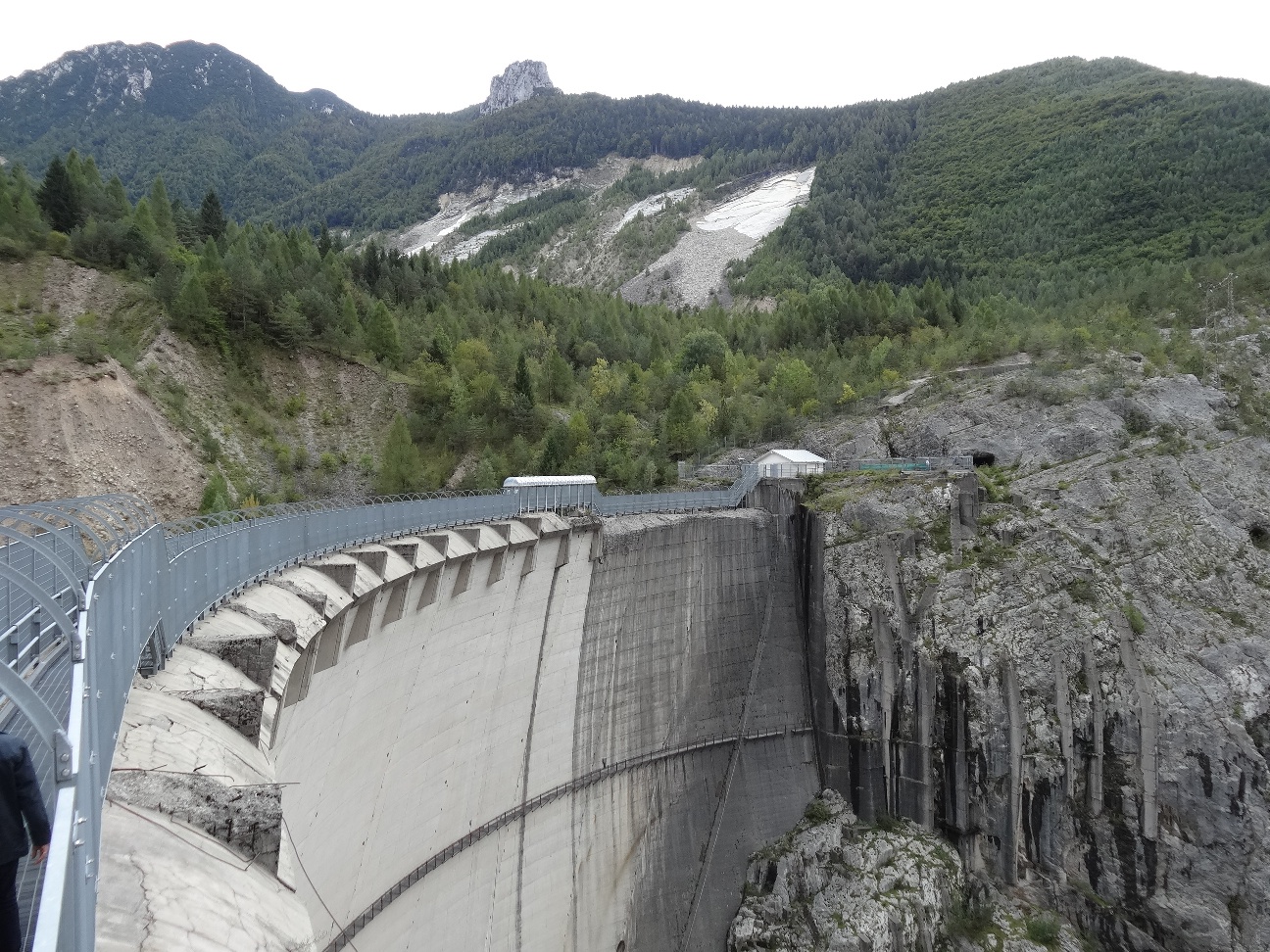
It is this latter case that occurred in Italy at the Vajont dam on the night of October 9 to 10, 1963. On the evening of October 9, an enormous landslide at an estimated speed of 90 km/h occurred in the reservoir during the first filling of this 260 m high dam. This landslide generated a wave more than 200 m high which overtopped the dam, causing the massive destruction of the town of Longarone and three other villages, resulting in more than two thousand casualties.
It is nonetheless remarkable to note that the dam structure and its abutments were barely damaged despite the significant overload.
An accident of the type that occurred at Vajont in 1963 has never occurred in France and remains extremely rare worldwide.
Since this accident, analysis of this risk has been carried out by dam project owners. The monitoring systems and measures in place make it possible to detect the warning signs of a failure several days before a disaster and to inform the Authorities. Consequently, this allows public authorities time to inform the public and organise evacuation if necessary; this is what is known as Special Intervention Plans (PPI).
The decision and organisation of the actual evacuation falls within the remit of the public authorities (Prefect).
The safety of a structure with respect to a landslide is ensured by regular monitoring and appropriate measuring sensors to assess developments. While the reservoir filling period is the most critical for a structure, it is necessary to continue this monitoring throughout its operation.
The measuring and monitoring systems put in place by dam operators ensure that if a landslide were to begin moving again, warning signs would make it possible to detect this and take appropriate measures to stabilise it, or in the worst case, evacuate the threatened population.
The advances made by science since the 1950s/60s, particularly in rock mechanics, allow us to better understand and better manage this risk. Furthermore, few of our sites are located in areas prone to landslides and the volumes of recorded landslides are very substantially smaller than those at Vajont.